Analysis of Iván Zulueta's Arrebato
May 7 2025
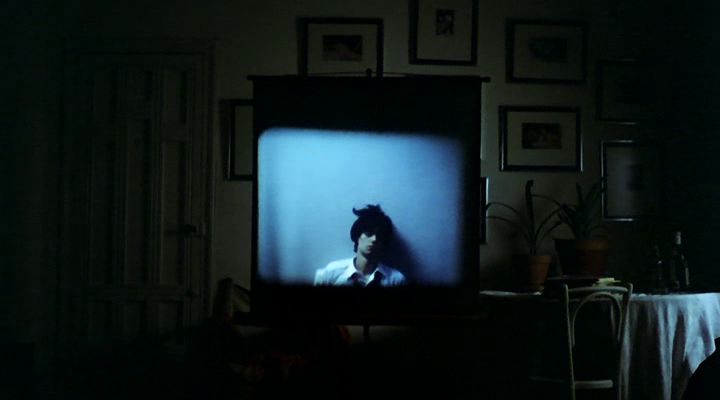
Arrebato 1979 [1980]
In 1979, Iván Zulueta, a counter-religious, counter-culture, youth-focused, drug and cinema-loving director released his second and last feature film: Arrebato (Rapture). Created by Zulueta in the peak of the post-Franco era that is "la transición," the film focuses on the rapture that comes with sex, drugs, and cinema.
Zulueta’s intent to combat the normative can be seen without having viewed the film at all. The title alone, Arrebato, comes with divine purpose, yet its vehicles in this film are all but holy. The rapture that Pedro, José, and Ana experience is derived from sexual exploration, drug exploitation, and a mysterious vampiric and cinematic ecstasy. Pedro dreams to become one with film, to remove himself from the human dimension and exist solely in the filmic one. To him, the idea of capturing, and more observing, the world through the inanimate eye is enrapturing. And to this, he becomes addicted, craving more and more until he becomes one with the tape, until it is he who is observed, ingested, and ceases to be human.
His obsession with repetition, with restarting until perfection is achieved, is a reflection of Zulueta’s reality, making Pedro to many extents an alter ego. “Los Super 8mm anteriores a este film…expresan este mismo testimonio de un modo a la vez más imperfecto y brutal que el largometraje” (Sánchez-Biosca, 1990, p. 99). Just as Pedro is constantly making new films, struggling to capture reality in fiction, Zulueta reworked his short films over and over until he could produce the masterpiece that is Arrebato.
While Zulueta explores anti-religious sentiment in the work, what he mainly explores is existential and metaphysical. He questions the notion that all humans on this terrain exist for a purpose, implying that perhaps some of us have an alien role to play, one outside of this dimension. As Pedro comes to question this, we understand that Zulueta himself is questioning it as well. Where the alter ego falls, so does Zulueta. He goes on furthermore to question not just the human purpose in this world, but the ontological existence of objects. He questions if objects retain their form and matter in this reality the same as they are captured on film. By the end of the film this is not so much of a question, but a statement.
Zulueta believes that the objects in a film are not the objects that exist amongst us, in a similar vein to Aristotelian philosophy where “form” refers solely to the essence or characteristics of an object: the principle of an object makes it what it is (Ainsworth, 2016). In Arrebato, objects assume a different essence and meaning in their physical configuration compared with their filmic configuration. Zulueta believes that humans exist much the same way, a category of objects among many. A human’s essence defines its form. Pedro’s essence and purpose is to see the world through a filmic lens, driving him to enrapture himself and become the lens itself. His meaning is derived from an otherworldly presence, it does not exist on earth. The arrebato provides him the metamorphosis he needs to become anew. He does not belong behind the camera, but in the camera itself.
To continue blending reality with dreamlike qualities, Zulueta paints a deep intersectionality between vampires, heroin, and cinema. As José edits his new film at the start, the audience is shown a brief glimpse of a woman rising out of her coffin. This vampiric symbol is planted to alert the audience toward a repetition of vampiric imagery throughout the film through the use of blood and humans drained of life. In Arrebato only two items are shown to draw blood: a heroin needle and a camera when its filmstock becomes increasingly more red. Both the needle and the camera act as a vampire in this sense. The needle pierces a human's skin just as a vampire’s tooth, taking with it a brief sacrifice of blood along with a total draining of the human’s lifeforce. The camera, like heroin, provides a brief ecstasy-filled moment, increasingly stronger and increasingly more draining. When it is done filming, and providing Pedro with his rapture, it gains more red frames, symbolizing the draining of Pedro’s blood until he has totally disappeared, transformed into a vampire himself.
On their second encounter, after both José and Ana have experienced true rapture, they lay on the couch and watch Pedro’s films. While all three are high, it is clear that Pedro’s high is different from the rest. Ana and José lay on the couch gelatinous, smiling, living in a world slowed to its highlights, Pedro is the opposite. He sits erect, eyes bulging, devouring grapes, juice dripping over his chin and clothing. He is wholly attentive for the film, for his exhibition, he is living through his work. The high, for him, is not the heroin in his system, but the world he has captured on film. His obsession with capturing the world becomes not only clearer in this scene, but more specific; he reveals that he defines the world by its consistency. At the one point in his creation when his camera moves from its normally stagnant position, he yells “Es el único fallo. ¡El único fallo!” It is the slight movement of the camera, of the observer of the world, not the unrealistic, slow frame rate of his films, that bothers him. The frame rate does not remove him from reality as it does Ana and José, because it is consistent. The consistency is harmonious and the absurdity, the abnormality, the consonance of reality in his attempts to capture the consistency, is what drives him insane.
During the viewing party, Pedro’s voiceover states, “Pero tener en cuenta que yo todavía creía en las cámaras que filman, en las cosas filmadas y en los proyectores que proyectan,” because in these three cinematic staples exist the consistency he seeks. The cameras that film have a standardized size of film, a specific number of frames to be shot, a regulated chunk of life that can be captured. The objects that are filmed are malleable, and will appear consistently the same if put under the same conditions, they are only what the camera makes them. A projector is mass produced equipment that, no matter which unit from which batch, will show the same film the same way as its other models.
Visually the scene is crafted with inconsistencies, with attention to the abnormalities, to contradict the fantasy that Pedro lives. The scene opens with different angles of the projection: one from the left, from the right, slightly zoomed in, slightly zoomed out, a medium full shot of Ana and José displaying their confusion, a medium shot of Pedro’s enamour. Everything in this scene exists to contrast. While the voiceover takes us further into Pedro’s fantasy, the scenery defines reality.
Narcissus was cursed to become obsessed with his reflection, he was both in love with it, and unable to be loved by it. His existence became a paradox, a self-lover who could not love himself, melting away from the fire of passion inside of him. He was an addict who could never reach an ecstasy strong enough to be satisfied, just as Pedro was.
With his camera, Pedro wishes to capture the true essence of nature: a paradoxical feat. To experience nature is to live it, to feel the inanimate living below one's feet, moving in the wind. “Pero esa placidez contemplativa…resulta esencialmente contradictoria con la capacidad posesiva, apropiativa de la imagen tecnológica, promesa definitiva de la (falsa) apropiación icónica del mundo” (Montero, 1990, p.103). Capturing nature on film is an attempt to carry its essence to cellulose, stripping it of its natural features and recreating it using its visual ones. Knowing this, Pedro feels an intense fear watching his own films, he knows that what he has captured can never quite be on par with human observance, he knows that he has failed. With cinema as his drug, he attempts to mirror reality. What he fails to realize is that cinema is not a mirror, it is an introspective tool. And thus, for much of the film, he is bound to a similar paradoxical fate as Narcissus: observing the world that seems so easily capturable, forever unable to capture it.
For many, drugs provide the ability to travel to the other side of the mirror. For José, his addiction gives him escape, slowing the world to be observed in its details rather than its entire composition. For Pedro, earthly drugs are simply not enough. Their repetitive ecstatic nature does not provide the variety nor the height of high he is seeking. Only when Pedro physically transforms himself to a single frame in his camera does he finally begin to feel that he has properly done his job. When he no longer can see the frame, but rather feel part of his essence missing, that is when he has achieved excellence, that is when he has reached the other side of the mirror.
While fictionally Pedro and José find the ability to transgress the earthly world into the filmic one, meta-textually Eusebio Poncela does as well. The actor as an individual exists only to most as what the screen tells the audience. Eusebio Poncela is a stranger to his viewers, his earthly essence dominated by his fictitious one. He exists not as a human individual, but as an alien actor. “La imagen del actor…se autonomiza, se hace independiente de su causa (el referente): es signo” (Montero, 1990, p.104). In viewing Arrebato, the audience forgets their preconceived notions of Eusebio Poncela, rewriting them to be those of José Sirgado. He is alienated from his reality, transformed into a filmic version of himself. In this sense, just like his character José, Poncela himself permeates into the filmic dimension. Poncela exists as the red spots on tape, as only a cinematic entity, his true human form exists in total blind spots of the average human mind.
In the end Arrebato culminates in a metaphysical journey where the boundaries between artist and medium, creator and creation, and reality and film dissolve completely. As Pedro descends into obsession with cinema as his form of drug, José follows closely behind. Pedro’s hypnotic voice message leaves José a victim to the vampire’s next bite, removing him from reality and transforming him into a projection on tape, the same fate as the actor Eusebio Poncela himself. Zulueta explores the seductive, erotic, vampiric, and hypnotic pull of the transcendental spirit of cinema. A mysticism that becomes both drug and a portal to the other side of the mirror, seemingly promising ecstatic epiphany, really only delivering a distorted reality. Arrebato is not the tale of becoming addicted to film, but the tale of attempting to live it. It questions the natural state of our universe, it questions how we define form and identity, it beckons its characters to break free of the restrained, claustrophobic, defined world, seeking a limitless one instead. Arrebato is Zulueta’s ode to cinema and the collapse of reality into obsession.
Works Cited
Ainsworth, T. (8 February 2016). Form vs. Matter (Stanford Encyclopedia of Philosophy). Stanford University. https://plato.stanford.edu/entries/form-matter/
Cartwright, M. (March 5 2023). Narcissus. World History Encyclopedia. https://www.worldhistory.org/Narcissus/
Montero, J. E. (June/August 1990). De Arrebato y algunas cosas más. Archivos de la Filmoteca, (6), 102–107. https://www.archivosdelafilmoteca.com/index.php/archivos/article/view/350/350
Sánchez-Biosca, V. (June/August 1990). Fragmentos de un delirio. Archivos de la Filmoteca, (6), 96–101. https://www.archivosdelafilmoteca.com/index.php/archivos/article/view/350/350
Zulueta, I. (Director). (1979). Arrebato [Película]. España: Nicolás Astiárraga P.C.